
The question we are most often asked is “what does the count mean on your yarns?”
Let’s try and answer that, taking our most popular cotton yarn as an example, Garnhuset Cotton 8/2NeC.
Understanding what the parts of a yarn count mean #
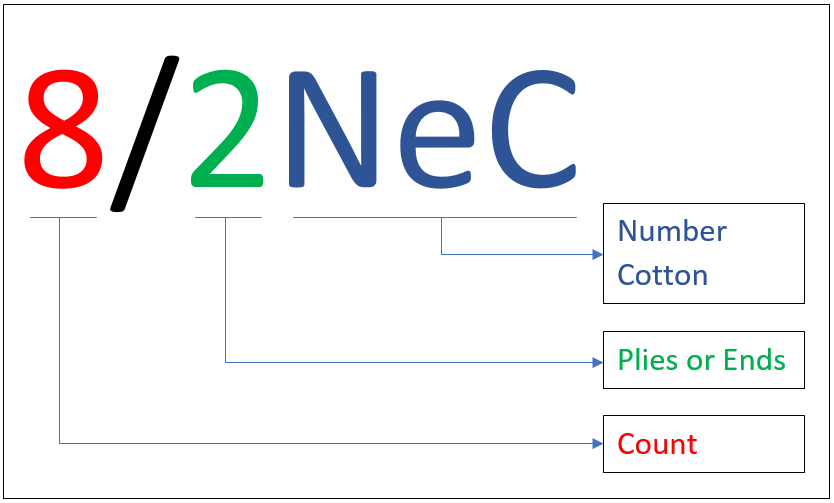
First we check the abbreviated unit, in this case NeC, meaning “Cotton Count”. It is sometimes also written Ne for “Number” or ECC for “English Cotton Count”. Cotton count and is a traditional unit of measure going back to the days when cotton was spun as a cottage business. A price had to be agreed for the length of yarns to be from a given amount of fibre, and 840 yards of cotton spun from a pound weight of fibre was defined as 1 count.
The cotton used to make the yarn in this example was spun out longer and thinner such that one pound weight yielded 8 x 840 = 6720 yards.
But if we unravel the cotton in this example we find that there are two ends, twisted around each other to make a two ply yarn. Plying, also called folding, gives strength to the yarn. The “2” in our yarn’s count tells us that there are two plies. Imagine taking that 6720 yards of single ply cotton, folding it right in the middle, and then twisting it all along its length. The same weight of cotton is now half the length it used to be, but about twice as thick.
A one pound weight of 8/2 Ne yarn measures 6720 ÷ 2 = 3360 yards.
Tip
The higher the count, the thinner the yarn. A 16/2NeC is approximately half the thickness of an 8/2NeC, and you will get twice the length for the same weight of yarn.
But remember, each ply adds to the thickness. So an 8/4Ne yarn would be roughly as thick as two ends of 8/2Ne.
There’s more than one type of count #
Here are the most common yarn count systems:
| Count | Abbreviation | Description |
| Cotton | NeC or Ne or ECC | Number of 840 yd lengths per lb. This count is also used for other cellulose fibres, e.g. Bamboo, Tencel. |
| Metric | Nm | Number of km per kg (or metres per gram). Can be used for any fibre. |
| Woollen | YSW or NeS | Number of 256 yard lengths per pound. Used for sheep’s wool, also called Yorkshire Skein Weight. |
| Worsted | NeK or NeW | Number of 560 yard lengths per pound. Used for sheep’s wool that has been subject to the worsted process of carding, combing and drawing before spinning. |
| Linen | NeL or LeA | Number of 300 yd lengths per lb. This count is used for Flax, hemp and other bast fibres. |
| Jute | NeJ | Number of pounds per 14,400 yards (a spyndle). |
| Dewsbury | Number of yard lengths per ounce. A woolen count almost exclusively used for carpet yarns. | |
| Tex | tex | The weight in grams of 1000 metres. |
| Denier | D or den | Number of grams per 9000 metres. |
Tip
If you look at the Additional information tab of each of our products you will see that we show information about its count. “Traditional Count” will be cotton count, worsted count or linen count, as appropriate. We also show the metric count which is a useful means of comparing yarns made of different fibres.
Comparing and converting #
Comparing yarns with the same count system is easy, but what if your yarns are labelled using different counts? You need to compare apples with apples, not apples with pears! The quickest way for our yarns is to look at the Additional information tabs and find the metric count for each yarn.
Converting between yarn counts is complicated, but we have a Yarn Count Converter on this website. Put in the count using the system you know, and the converter tells you the equivalent in seven of the most common yarn count system.
Our yarn count converter also allows you to enter the weight you have of the yarn to calculate its approximate length!
So what is 3×2/16ne? #
We are often asked about this count, usually by readers of Anne Dixon’s “Handweaver’s Pattern Book”. It confuses many people because the count and ends are reversed. Here’s what it means:
- 1 pound of cotton is spun to 16 x 840 = 13,440 yards.
- It is folded to make a two ply yarn (6,720 yards) which we would describe as 16/2 NeC.
- Three lengths of this yarn are then spun or twisted together to make a thicker yarn, 16/2×3 NeC.
Why do we prefer to write it as 16/2×3 NeC? Because it is made from 16 count cotton and if you untwist the end of such a yarn you will find 2×3 = 6 ends.
If we calculate an effective count we get 16 ÷ (2 x 3) = 2.7 NeC. Which is very close to a 5/2 NeC yarn, effectively 2.5 NeC, which we find much easier to work with as both a warp and a weft.
More help with counts #
We’re happy to offer help with yarn counts and conversions, use the contact us form or send an email to [email protected] – if you have a label for your yarn include a photo!


